


WHAT PLACE DOES THE CHURCH HOLD IN THE POLITICAL SPHERE IN CAMEROON?
Jean-Paul NDONGO
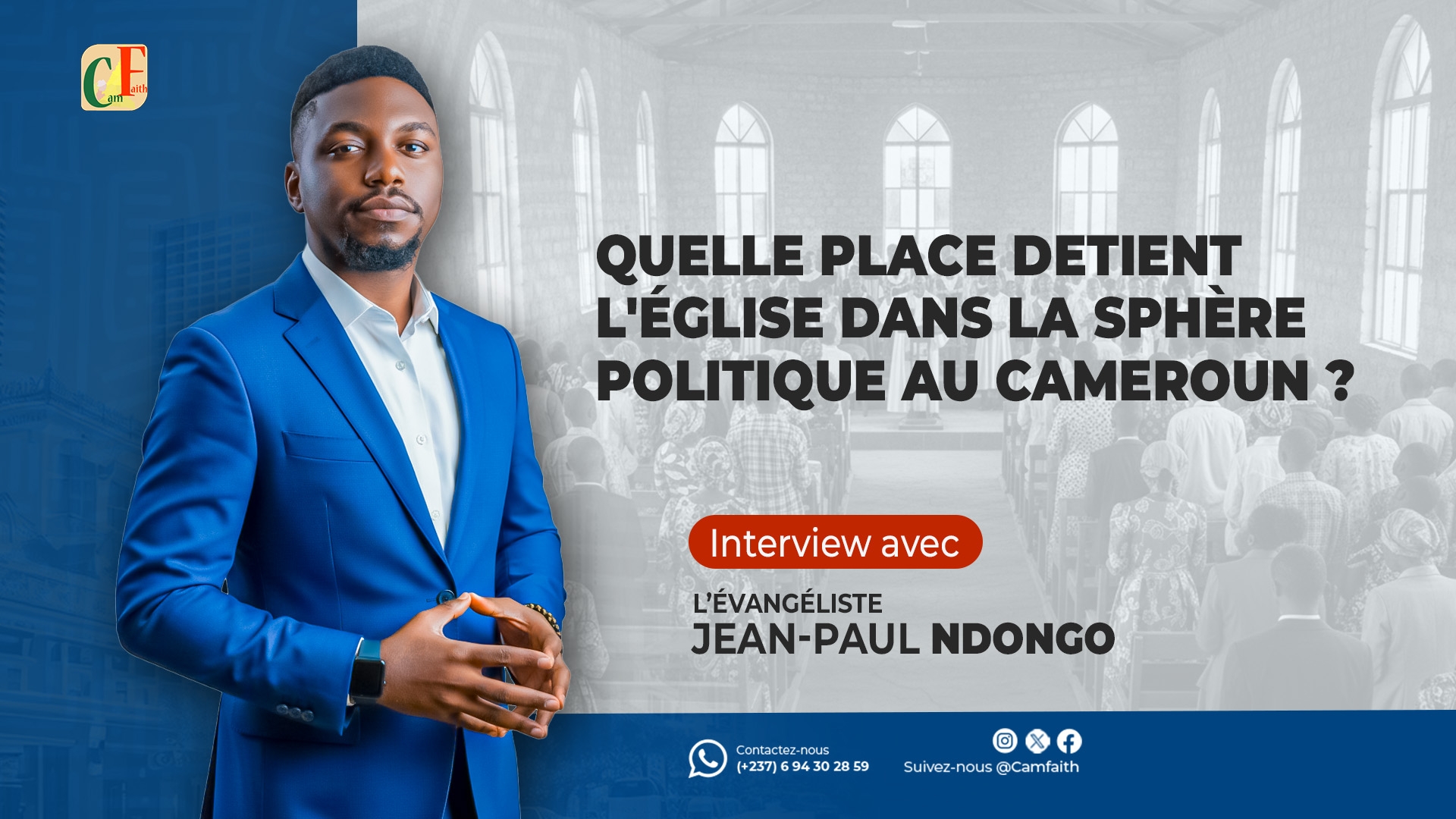
In a context marked by profound political, social and cultural changes, the question of the place of the Church in Cameroonian public life remains at the heart of the debates. Between spiritual mission, civic commitment and moral responsibility, the Church appears as an actor whose influence goes far beyond the strictly religious framework. To shed light on this theme and analyze the current and future role of the Church in the national political sphere, today we welcome Jean-Paul Ndongo, Evangelise, teacher, observer of religious and political dynamics, engaged in reflection on the issues of governance and social transformation. With him, we will try to understand the foundations, modalities and perspectives of ecclesial action in Cameroon.
Journalist Leonard A.: How do you perceive the legitimacy of the Church to intervene in political questions in Cameroon? On what foundations (theological, moral, historical) is this intervention based?
Jean-paul Ndongo: The Church has an indisputable legitimacy to be involved in political governance, based on three essential pillars: On the theological, moral and historical level. Theologically, Jesus Christ unequivocally establishes the role of the Church in Matthew 5:13-14, where His followers are referred to as the “salt of the earth” and the “light of the world.” This Divine mandate gives the Church the vocation to enlighten society, to bear moral witness and to inspire just principles in the management of the city.
Morally, the defense of justice, peace and human dignity falls fully within the ecclesial and priestly mission of the Church. Historically, in our country as elsewhere, the Church has always been a catalyst for social emancipation and political stability. To deny the Church this role would be to ignore its Divine call to positively influence society in the service of the common good and the truth, without sinking into partisan sectarianism (arbitrary position taken for a political program)
Journalist Leonard A.: What are the concrete means by which the Church should exercise its influence in the Cameroonian political sphere? Can you give recent examples of significant interventions?
Jean-paul Ndongo: The influence of the Church is deployed above all through its members, the committed Christians individually or collectively. Each child of God is called to proclaim the kingdom of God and manifest its values in the public sphere, including in politics. This sacred responsibility is exercised through civic education, participation in debates, the promotion of social justice, as well as through direct presence in state institutions.
Concrete examples illustrate this dynamic: in Gabon, pastors like Laurence Ndong have embodied rigorous political leadership imbued with integrity as minister. In Congo, Grace Kutino has an exemplary ministerial commitment to young people. In Cameroon, personalities such as Cabral Libii, MP and defender of social causes, or Minette Libom Li Likeng, manager recognized in her public functions, testify that faith can be an engine of excellence and reform.
Journalist Leonard A.: How do you characterize the relations between the Church and the Cameroonian government? Have these relationships evolved over time, particularly under different regimes?
Jean-Paul Ndongo: Church-State relations in Cameroon are complex and ambivalent. In certain respects, they can be incestuous, when certain ecclesial fringes adopt a servile posture, relaying the discourse of power to the detriment of their moral independence. This co-optation harms the prophetic mission of the Church.
However, the Church remains a vital vector of social peace, of living and succeeding together, capable of providing a necessary spiritual counterweight in a society marked by tensions. Paradoxically, while some withdraw from political action, distracted by the idea of a heavenly paradise that expects nothing from them on earth, the Church remains an ethical refuge and an essential interlocutor in the search for the common good. the limits or obstacles to its action in politics?
Jean-paul Ndongo: The Church in Cameroon is today fragmented, without an elected spokesperson capable of representing the diversity of its clergy and its faithful. This lack of unified leadership weakens its ability to develop a coherent strategy for political intervention. Often, actions are scattered, contradictory, even harmful because of prophecies or poorly calibrated speeches such as religious officers who advocate the replacement of a man by the "devil" or even announce apocalyptic scenarios which are aborted when the deadline arrives.
Yet, Christians involved in the State apparatus work to influence policies from within, they say, for the common good. The main limit to this potential lies in the temptation to compromise. Refusing any compromise at the heart of corruption and misappropriation of public funds is imperative, because the Church is called to be a responsible decision-making body, embodying the Ecclesia revealed by Jesus: a community that legislates in line with the interests of the Kingdom of God.
Journalist Leonard A.: What role should the Church play in the political future of Cameroon, particularly in the face of current challenges (Anglophone crisis, democratic transition, generational succession)?
Jean-Paul Ndongo: The Church must reconnect with its essence: to be the active body of Christ in the world. Its role is to educate consciences about political responsibility, to raise the voice of justice, to create bridges between communities and to call for national dialogue.
It must organize its active forces to intervene concretely in crisis areas, propose viable social solutions, and promote an ethic of governance. The Church must not be neutral, but nevertheless preserve its dynamic impartiality which aims to promote the common good, by fully assuming its prophetic and civic role.
Ultimately, the Church remains a major player in the construction of living together and the search for the common good in Cameroon. If his involvement in the political sphere must be exercised with discernment, integrity and a sense of mission, it cannot be limited to silence or withdrawal. Its role is to enlighten, support, educate consciences and constantly remind us of the ethical requirements that underpin just governance. Through a responsible presence, open to dialogue and faithful to its values, the Church can contribute significantly to the dynamics of peace, justice and social transformation that the country needs.
🔍 Quick search
Quick filters:
👤 Other articles by Leonard Awono
Great Gospel Festival in Douala: Jesus Christ, the...
Special Seminar for Couples & Singles 2026: Buildi...
Launch of the Village Branch of NEW FOUNDATION MIN...
THE GENERATION OF PRECURSORS WITH MINSARES
BRICE TEHILLAH LIVE: A NEW CONCERT ON JUNE 20, 202...
ADAAB signed Yves Akini soon available
WORSHIP MOVE - ACT 1
MULEMA GOSPEL TALENTS 2026: ANY SURPRISES?
At the dawn of true forgiveness: Jean-Paul NDONGO ...
📅 Gospel Agenda
July 2026
August 2026
📋 Coming events:
Advertisement
Your advertisement here
300x250 px
Comments