


The war in the Middle East: fear or call for peace? A biblical and theological insight from Rev. Dr Alphonse TEYABE
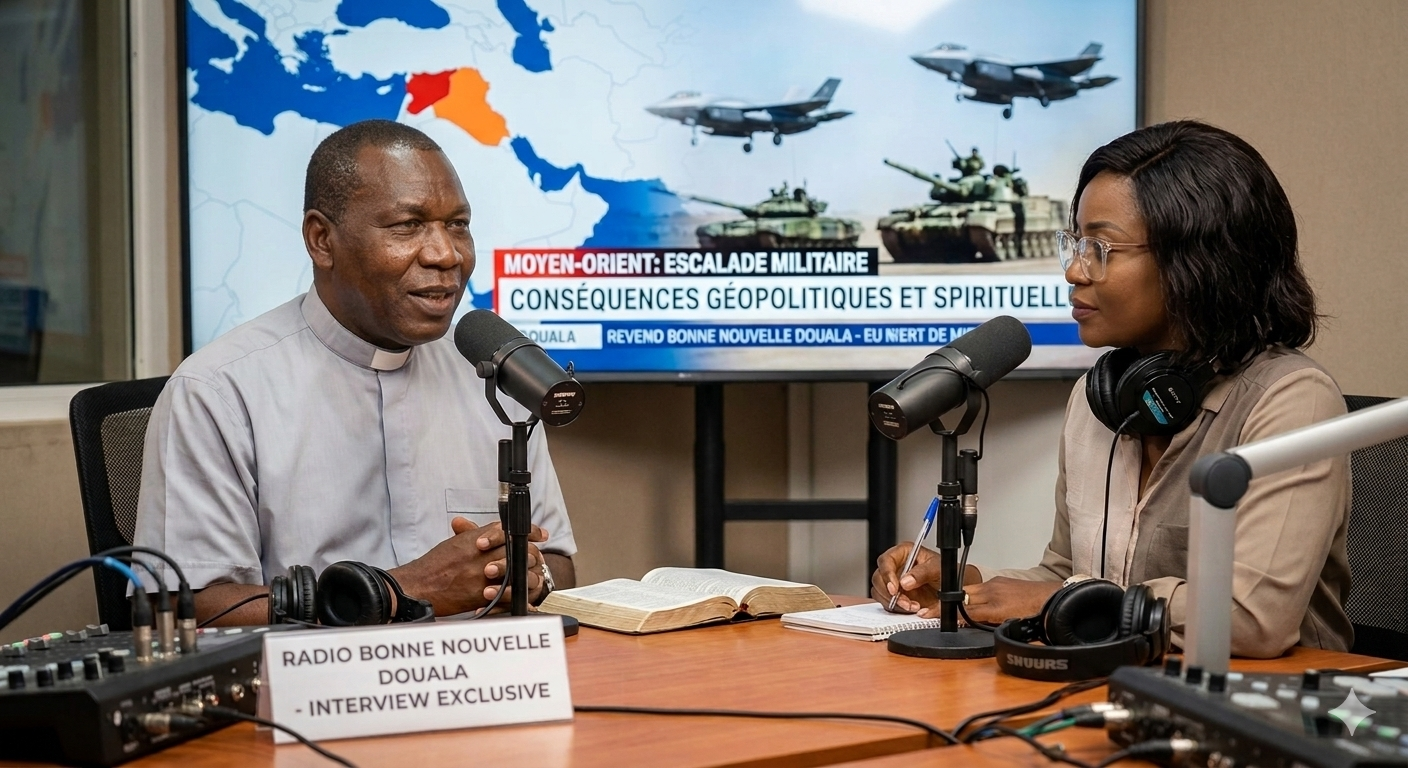
In an international context marked by strong tensions in the Middle East, with the military escalation involving Israel, Iran and the United States, concerns are growing about the geopolitical, economic and spiritual consequences for the entire world, including Africa. Faced with this worrying situation, theological and ethical reflection appears necessary to enlighten consciences and recall the biblical call for peace, the responsibility of nations and prayer for people.
To better understand the scope of this crisis in the light of the Christian faith, Reverend Doctor Alphonse TEYABE answers questions from Jeannine Yongo Etha, journalist at Radio Bonne Nouvelle Douala.
On the radio microphone, he offers a reading to both biblical, theological and geopolitical of current events, inviting Christians to avoid simplistic interpretations, to maintain a moral conscience in the face of international conflicts and to remain peacemakers in a world crossed by violence and uncertainty.
This interview returns in particular to the biblical significance of the war in the Middle East, to the reasons for the constant support of the United States for Israel, and to the role that the Church must play today as a prophetic voice, calling for wisdom, for prayer and in search of peace between nations.
1) Doctor Alphonse TEYABE, what is the biblical significance of the current war in the Middle East with the strikes of the USA and Israel on Iran and the consequences on other countries?
From a biblical perspective, current tensions in the Middle East, particularly involving the State of Israel, Iran and the United States, must be approached with caution and discernment. The Bible affirms that God remains sovereign over the history of nations (Daniel 2:21), but it does not authorize us to interpret every conflict as the direct fulfillment of a prophecy. Jesus himself warns that we will hear of wars and rumors of wars, but that does not necessarily mean the end (Matthew 24:6).
In Scripture, Israel has a special place in salvation history, but the New Testament shows that God's plan extends to all nations. The Church must therefore not read modern conflicts only with a simplistic prophetic framework, as if each war immediately announced the end of times. The Christian mission remains the proclamation of the Gospel and the search for peace.
The Christian tradition, from Augustine to Thomas Aquinas, recalls that even when a war is invoked as necessary, it must meet strict moral criteria: just cause, proportionality and protection of the innocent. However, current conflicts above all show the moral fragility of the world.
The main biblical significance is therefore not to announce the end of the world, but to call believers to spiritual vigilance, to prayer for the nations and to commitment to peace, because “blessed are the peacemakers” (Matthew 5.9).
2) Why is the United States always ready to protect Israel?
The constant protection of Israel by the United States is explained first and foremost by geopolitical, historical and strategic reasons, before being religious. Since the creation of Israel in 1948, the United States has considered this country as a major ally in the Middle East, a region essential for global balance because of energy resources, trade routes and rivalries between great powers.
Strategically, Israel is seen as a stable partner in an area marked by numerous conflicts. The United States thus seeks to maintain its influence against other powers such as Russia or China. This alliance is therefore largely based on political, military and economic interests.
However, there is also a religious dimension. A significant portion of the American evangelical world believes that support for Israel is God's plan in history. Some refer to the promises made to Abraham (Genesis 12:3) to justify special support for the Jewish people. This conviction sometimes influences American policy, even if the State acts primarily according to its national interests.
From a theological point of view, we must remain balanced. God loves Israel, but he also loves all nations. The Church must not confuse the Kingdom of God with the strategies of earthly powers. The role of Christians is not to justify war, but to call for justice, responsibility and peace among people.
3) Concretely, what should Christians do in the face of this war in the Middle East? Should they see it as a sign of the times or a call to prayer and commitment to peace?
Faced with the current war in the Middle East, Christians must above all adopt an attitude of spiritual discernment, moral responsibility and prayer, rather than giving in to fear or hasty interpretations. Jesus clearly warned that we would hear of wars and rumors of wars, but he also added: “Be careful not to be troubled” (Matthew 24:6). This means that not all conflicts should automatically be seen as immediate signs of the end times.
World history has always been marked by tension, rivalry and war. The Bible does not call us to live in permanent anguish, but in vigilance and hope. Seeing each crisis as the direct fulfillment of a prophecy can lead to simplistic and sometimes dangerous readings, which distract believers from their true mission.
Concretely, Christians are called to pray for nations, for leaders and for suffering peoples, in accordance with the exhortation of the apostle Paul (1 Timothy 2.1-2). Prayer is not an escape, but a spiritual responsibility, because it reminds us that God remains sovereign over history.
At the same time, the Church must be a prophetic voice in the world, calling for justice, restraint and the sincere search for peace. Jesus declares: “Blessed are the peacemakers, for they will be called sons of God” (Matthew 5.9).
Thus, more than a reason for fear, this crisis must be for Christians a call to faith, lucidity and commitment to peace.
4. Donald Trump is contested but also supported by Christians. Can we, in the light of the Bible, see him as a David facing the great powers?
Comparing a contemporary political leader to David in the Bible requires a lot of caution. In the Scriptures, David is not only a war leader, he is first and foremost a man chosen by God to accomplish a particular mission in salvation history. The Bible also shows that David was not perfect: he made serious mistakes, but he was a man capable of repentance and humility before God. Using this figure to justify or condemn a modern political leader can lead to simplistic interpretations.
The support of certain Christians for Donald Trump is often explained by moral, cultural or political reasons, particularly on issues linked to religious freedom, the defense of certain conservative values or the protection of Israel. However, the Christian faith must never be totally identified with political power. The Gospel reminds us that the Kingdom of God is not to be confused with any nation or with any leader.
Saying that a president would be a “David” in the face of great powers may be a symbolic image, but it should not become an automatic spiritual justification. The biblical criterion remains justice, truth, mercy and the search for peace.
Christians are therefore called not to idolize leaders, but to pray for them, to exercise discernment and to remain faithful to the Gospel.
🔍 Quick search
Quick filters:
👤 Other articles by Clovis Fotso
Live Concert: Russell Missima and El Netsah Choir ...
Douala: “Sound of Glory” officially launches t...
OFFICIAL RELEASE | “The Ten Biblical Dispensatio...
WAR IN THE SKIES: THE METAMORPHOO CHRISTIAN CENTER...
Elsah Meguy delivers “My Dream Come True”: a h...
Dubai welcomes “The Atmosphere”: a night of pr...
“DEDICATION & CONCERT”: LAURE NTAMACK BINYET S...
Giant” around the theme of viral influence
COURSE ON PRAYER IN DOUALA: THE WORLD UNIVERSITY O...
📅 Gospel Agenda
July 2026
August 2026
📋 Coming events:
Advertisement
Your advertisement here
300x250 px

Comments